Saturday, April 15, 2017

End Credits


Dear Out 1 Film Journal Readers of the Past, Present, and Future,

How have you all been? I write you today what will be the final post here at Out 1 Film Journal. This will likely not come as a surprise, as the site has been pretty inactive for a while. But I wanted to write here both to make it official, and to provide a short reflection along with an update.

I started Out 1 in Fall 2007 when I moved to New York City for an MA Program in Film Studies at Columbia University. This week, almost a decade later, I successfully defended my PhD in the History of Art department at The Ohio State University. I will be relocating this summer to Rochester, NY with my wife. The journal has been there all through this process. Having reached the culmination of it, I feel it is an appropriate time to close up shop. 

I hope there have been posts, discussions, and reviews that will continue to be of value to some of you out there. I'll continue to pay my dues to keep the site active as an archive of the writing that has been published here over the last decade. 

Thank you to Brandon, Chuck, and all the other writers and contributors. Thank you to the Columbus Film Critics Association (COFCA) for allowing me to join your ranks. Thank you to every person who has ever taken the time to be a reader. I truly appreciate your time, your thoughts, and your support. You are what made this site important and alive all of these years. Thanks to all of you from the bottom of my heart. 

Here's to you all, and to whatever comes next. 

cheers,
james


Continue reading...

Wednesday, June 1, 2016

Crossroads Film Festival 2016 at The Brooklyn Rail


I was once again given the opportunity to write about the annual CROSSROADS for The Brooklyn Rail. Films by Ben Rivers, Josh Gibson, Peter Burr, Meredith Lackey, Heather Trawick, Mike Stoltz, Karen Yaskinsky, and Michael Robinson.

http://www.brooklynrail.org/2016/05/film/continuing-interference-crossroads-2016


Continue reading...

Wednesday, May 20, 2015

Crossroads Film Festival at The Brooklyn Rail


I was given the opportunity to write about San Francisco's great CROSSROADS Film Festival at The Brooklyn Rail. Films include Ross Meckfessel's The Golden Hour, Basma Alsharif's A Field Guide to the Ferns,Guillaume Cailleau's Laborat, Ben Russell's Greetings to the Ancestors, and others.

Check it out. Continue reading...

Monday, April 27, 2015

2015 Ann Arbor Film Festival at Filmmaker Magazine


I was given the opportunity to write about the fantastic Ann Arbor Film Festival for Filmmaker Magazine. Films include the work of Tacita Dean, programs on experimental cinema in Eastern Europe, Greg Zinman and Leo Goldsmith's curated program "Computer Age," Harun Farocki's essential Parallel series, Lonnie van Brummelen and Siebren de Hahn’s Episode of the Sea, Félix Dufour-Laperriere’s Transatlantique, Mike Holboom’s Scrapbook, and Simone Rapisarda Casanova’s award winner The Creation of Meaning.

Check it out.  Continue reading...

Monday, February 23, 2015

Top 13 Films of 2014


by James Hansen
Looking at the works on this list, there aren't necessarily many connections. They range from shorts to features, narrative to documentary, Hollywood to experimental. Still, I think lurking below the surface of many of the best works of the year (and recent years) is a unique emphasis on spatial dynamics, both internal and external. Space and the surrounding environment become imbued within the characters, images, and hidden stories of these films. Further, each of these moving image artists shows an awareness of how the feeling of those spaces has the ability to transfer onto and into the viewer's body. At times disorienting, irritating, and/or overwhelming, these films place demands on the minds, eyes, and bodies of their viewers (not to mention their performers), and ask for a willingness to play in games without ever knowing all the rules. Active investigations don't need to end when the movies do. 

Here are my Top 13 Films of 2014. 


1. Goodbye to Language (Jean Luc Godard)


2. The Strange Little Cat (Ramon Zürcher)


3. Inherent Vice (Paul Thomas Anderson)


6. Story of My Death (Albert Serra)


9. Actress (Robert Greene) 


10. Selma (Ava DuVernay)


12. The Babadook (Jennifer Kent)


13. John Wick (Chad Stahelski and David Weitch)

Continue reading...

Wednesday, December 3, 2014

Sylvia Schedelbauer at Cléo: A Journal of Film and Feminism


I was given the chance to write about Sylvia Schedelbauer, one of the most exciting experimental filmmakers of recent years, at Cléo: A Journal of Film and Feminism. Thanks to Kiva Reardon and everyone at Cléo for the opportunity. Check it out.

http://cleojournal.com/2014/12/03/women-to-watch-sylvia-schedelbauer/ Continue reading...

Thursday, June 5, 2014

Tuesday, January 14, 2014

Out 1 Film Journal's Top 13 Films of 2013

by James Hansen 

While not quite on purpose, this list reflects the desire for unique images, assemblages, and experiences outside the confines of traditional narrative, character, and story; further, it illustrates a wide range of artists who expand, complicate, and question this inclination across fiction and documentary, narrative and experimental. These films epitomize a consistently paradoxical, often historical negotiation with images, the process of their construction, and their external (and cultural) mobility. Operating through what Blanchot calls "the happy chance of unconcern," these artists have made solitary, striking, slippery, wonderful works that I won't soon forget.

 
2. Computer Chess 
(Andrew Bujalski)

 3. Let Us Persevere In What We Have Resolved Before We Forget 
(Ben Russell)

4. Spring Breakers 
(Harmony Korine)

 5. Life Is An Opinion (Fire A Fact) 
(Karen Yasinsky)

 6. Post Tenebras Lux 
(Carlos Reygadas)

 7. Let Your Light Shine 
(Jodie Mack)

 8. Frances Ha 
(Noah Baumbach)

9. Beyond The Hills 
(Cristian Mungiu)

 10. The Lords of Salem 
(Rob Zombie)


 12. Viola 
(Matías Piñeiro)


BEST UNRELEASED FILM

 Hard To Be A God
(Aleksei German) 

Continue reading...

Tuesday, November 26, 2013

Exhausting Tomorrow: Michael Robinson's "The Dark, Krystle" (2013)


INEZ: But, you crazy creature, what do you think you're doing? You know quite well I'm dead.
ESTELLE: Dead?
INEZ: Dead! Dead! Dead! Knives, poison, ropes--useless. It has happened already, do you understand? Once and for all. So here we are, forever.
ESTELLE: Forever. My God, how funny! Forever.
GARCIN: For ever, and ever, and ever.
(A long silence.)
GARCIN: Well, well, let's get on with it...

by James Hansen

Over the image of a fire burning blue, we hear the faint, exhausted whisper of a middle-aged woman. “There was a fire in the cabin. I tried to leave, but the door was locked. I died in that fire...” The woman sits in a hospital bed. Her head slightly tilted, she gazes into the distance with a look of despair. “I don’t know who I am.” These sounds and images serve as the prelude of Michael Robinson’s new video The Dark, Krystle. They establish the work’s central premise, that of being trapped in a place with no hope of escape. And yet, the narrator doesn’t die, despite stating her condition as being dead, as no longer knowing herself. She is alive, born new even, but lacks an awareness of herself, of her life, of her history.

Continue reading...

Tuesday, October 1, 2013

Living Variables: Stephanie Barber's "Daredevils" (2013) and David Gatten's "The Extravagant Shadows" (2012)


by James Hansen

On Sunday, as I wandered through David Gatten’s monumental feature The Extravagant Shadows for the second time, my mind kept returning, quite unexpectedly, to Stephanie Barber’s Daredevils, a new feature-length video premiering this Thursday at the New York Film Festival’s Views from the Avant-Garde sidebar.        

Continue reading...

Thursday, September 26, 2013

Museum Hours (Jem Cohen, 2013)


by James Hansen

A tender, intimate portrait of care and friendship, life and art, Jem Cohen’s Museum Hours may be best observed in the position of a wanderer. Anne (Mary Margaret O’Hara) makes an unexpected trip to Vienna to care for a dying family member. In Vienna, Johann (Bobby Summer), a museum guard, befriends Anna. He becomes her guide and they travel around a number of unique spaces – the hospital, the museum, and the city at large. Cohen’s fine directorial eye shows Anne and Johann as almost floating around the city. The beautifully rendered scenes softly flow from one to the next, as if they are leaves blowing in the wind or billiard balls gliding across a table.

Continue reading...

Wednesday, September 4, 2013

NYFF: 2013 Views from the Avant-Garde Schedule

Scott Stark, The Realist, 2013

Schedule for NYFF Views

T
he Film Society of Lincoln Center announced today the complete lineup for the 17
th edition of Views from the Avant-Garde (VIEWS), taking place from Oct 3-7 during the New York Film Festival (NYFF). The popular yearly touchstone for experimental film returns with curator Mark McElhatten at the helm, and will contain 35+ programs in glorious Super-8, 16 mm and 35mm film and HD formats. Many familiar faces will return, and VIEWS will also feature 45 new artists and several mini-retrospectives of several of these artists including, Aura Satz, Lois Patiño, Sandro Aguilar, and Jean-Paul Kelly. Views will also offer special tributes to the late Stom Sogo and Anne Robertson whose work is a testimony to the power of a Cinema that is fearless, confidential and inextinguishable.

Curator of Views from the Avant-Garde, Mark McElhatten said, “Cinema existed before Film and will exist long after film's twilight and digital's decay. Cinema exists as an innate way of perceiving the world through light, through cadence through juxtaposition and as a way of sensing and organizing reality. VIEWS celebrates Cinema in its material marriage with film, in its honeymoon period with an ideal medium, projecting super-8, 16mm, 35mm, sequential slides. We celebrate the lightning fleetness of digital that is able to translate the cinema of consciousness in a way than is very different than film, giving it a different elasticity and a different body. We are screening work that ranges through the ethnographic, abstract, psychological, documentarian, essayistic, devotional, parotic, scientific-naturalist many different impulses and directions along with the latest archival preservations of rediscovered works from earlier decades. The goal is to offer a festival of works that is evidence of true exploration coming from individual impulse, showing what can happen when exceptional artists absent themselves from the concerns of a consensus commercial aim and authentically pursue the limits of their art.”

Some highlights this year include, work by Lois Patiño who will showcase multiple programs, group shows, solo and amphitheater cycles. Opening night offers the North American Premiere of Patiño’s first feature COSTA DA MORTE, which just won an award of distinction at the 66th Festival del Film Locarno for Best Emerging Director. Filmed in a region of Galicia, Spain called Coast of Death, derived from the numerous shipwrecks that happened in this region. The film crosses this land observing the people who inhabit it, witnessing the traditional craftsmen who maintain both an intimate relationship and an antagonistic battle with the vastness of this territory. The wind, the stones, the sea, the fire, are characters in this film, and through them, approach the mystery of the landscape, understanding it as a unified ensemble with man, his history and legends.

Sandro Aguilar is known internationally as the founder of the production company, “O Som e a Fúria,” responsible for acclaimed films by Miguel Gomes, Manoel de Olivera and many other notable directors. His extraordinary films have been receiving nominations and awards from dozens of festivals worldwide over the last decade or so. Aguilar’s latest film Dive: Approach and Exit will be shown in its New York Premiere along with a selection of short films from 2007 to 2013. In addition his film A Serpente will screen once with the New York premiere of Scott Stark’s The REALIST.

VIEWS will present the World Premiere of Aura Satz’s just completed work Doorway for Nathalie Kalmus, a film centered around the use of color in moving image technology and exploring the disorienting technicolor prismatic effects of the lamp house of a 35mm color film printer. Through minute shifts across an abstract color spectrum, punctuated by a mechanical soundtrack, the film evokes kaleidoscopic perceptual after-images (bringing to mind Paul Sharits, Dario Argento and the Wizard of Oz).

SUNKEN TREASURE will be part of a special closing day of VIEWS that seeks to dissolve boundaries in the way we categorize and approach cinema of different origins and genre by presenting relative rarities directed by John Stahl and Max Ophuls, along with the works of Stan Brakhage and Nathaniel Dorsky. The evening will conclude with the last presentation in this year’s edition of VIEWS titled Kodachrome Dailies from the Time of Song and Solitude (Reel 2)by Nathaniel Dorsky, includes screening unreleased materials for the first and only time to a public audience.

Over 200 individual works will screen this year from all over the world, including: Argentina, Austria, Australia, Brazil, Burma/Myanmar, Canada, Ethiopia, France, Germany. Israel, Italy, India, Japan, Palestinian territories, Mexico, Nepal, the Netherlands, Nigeria, Norway, Portugal, South Korea, Spain, Turkey, Uganda, United Kingdom, United States, Vanuatu and Venezuela.

Director Stephanie Spray and Pacho Velez’s film Manakamana will be co-presented by Views from the Avant-Garde and was previously announced in the Spotlight on Documentary section, Motion Portraits. The film will screen on September 28 and 30 with the filmmakers in attendance. Visit Filmlinc.com for more information.

The 17-day New York Film Festival highlights the best in world cinema, featuring top films from celebrated filmmakers as well as fresh new talent. The selection committee, chaired by Kent Jones, also includes: Dennis Lim, FSLC Director of Cinematheque Programming; Marian Masone, FSLC Associate Director of Programming; Gavin Smith, Editor-in-Chief,Film Comment; and Amy Taubin, Contributing Editor, Film Comment and Sight & Sound.

Gain access to the 34 programs in Views from the Avant-Garde with a $99 NYFF Views Badge, which will be available for purchase exclusively online. The badge as well as tickets to individual programs will go on sale September 12th.  More ticket information for the New York Film Festival will be available on Filmlinc.com/NYFF.

Complete schedule after the break.


Continue reading...

Saturday, August 17, 2013

Has-Been History: The Impossible Call and Response of Lewis Klahr's "Candy's 16!" (1984)


by James Hansen

This is the text from a paper presented at the 2012 Society for Cinema and Media Studies conference in Boston, Massachusetts. It remains a work in progress.

A girl named Candy sits alone at her 16th birthday party. A pop record plays quietly in the background. It starts to skip. An untouched birthday cake rests on a table in front of her. Sixteen candles remain unlit. There is no need to light them. For Candy, they are already extinguished. Her friends didn’t come to her celebration. In fact, they couldn’t come. It turns out this party wasn’t today or yesterday. It was years ago. But, for Candy, it is tomorrow. It is always tomorrow. She awaits an event – a future – which will never come, although perhaps it already has. Instead, she lingers in a present moment, hermeneutically sealed off from the yesterday of her adolescence and the tomorrow of her adulthood. She isn’t on a precipice – she is locked in it. As such, she becomes a forgotten figure in her own world. A has-been in her own being. 

This is a vision extrapolated from Lewis Klahr’s 1984 short film Candy’s 16!, part of his “Picture Books For Adults” series (1983-1985). In this series, Klahr gestures toward history as both static and moving. Constructed of eight 8mm short films, Klahr uses a variety of techniques – found footage, splicing, as well as his well known cutout animation style – and creates collages from ephemeral, cultural fragments – home movies, comic books, advertisements, and pop music. with a career and signals many of the concerns of which he continues to work through – history, memory, and the recent past. Stripping objects from their specific contexts, Klahr’s films reference the outmodedness of their objects through a self-referential temporal lag – that is, they are lapsed historical objects. The objects and images enter into dialogic communication allowing them to intersect both historically and aesthetically; his films display a process of an ongoing, irresolvable dialectical history: a history of the present’s past and the past’s presence – or, as Klahr himself says, his films illustrate “the pastness of the present.” 

This paper will examine Candy’s 16! as a model of what I am calling, following Walter Benjamin, “Has-Been history” – a conception of history understood through outmoded, forgotten objects and commodities. For Klahr, objects are “has-beens” lying dormant in historical ruins waiting to be revived. The stakes of this revival is central to this paper and Klahr’s work in general. Klahr has become well-known for his cutout animation techniques, yet Candy’s 16! is a more traditional found footage film. This may make it a somewhat odd choice for extended analysis. However, I argue Klahr’s approach, even in the early stages of his career, indicates the mission of has-been history  – the purpose is not to pace an object historically, but rather to uncover the irresolvable tensions between the historical context and the cultural moment in which materials are extended. Candy’s 16! operates as a transhistorical exchange in which the images of has-been history are revealed as irretrievably fractured. Klahr grants them new visibility only to have them quickly evaporate and remain unrealized. Candy’s 16! questions how personal materials, cultural memory, and the audience negotiate such a schism. Is this all an introduction or a farewell? As Candy awaits her party, celebrating her passage from adolescence to adulthood, Klahr indicates that has-been history can be called, but it cannot respond. History reverberates. Klahr’s films gesture toward its incommensurable aftershocks.


Continue reading...

Monday, July 15, 2013

A Tidy Mosaic: Stories We Tell (Sarah Polley)


by James Hansen

Sarah Polley’s Stories We Tell maps out the mosaic-like narrative of her discovery that her father, Michael Polley, was, in fact, not her biological father. In making a film about her past and the relationship of her parents, Polley’s story spans her entire family history, stretching across space and time to reconstruct the story of her mother and the extramarital affair that lead to her birth. The film includes interviews with various family members and archival 8mm home footage, as well as reenactments of false events and recreations of supposedly ephemeral material. The film attempts to grapple with the refracted shards of fact and fiction, history and memory. Indeed, Polley’s narration and the possibly false interviews of actors playing Polley’s siblings*** point the audience directly toward these ambivalences time and again. While there remain moments in which the curtain is specifically lifted, Stories We Tell doesn’t attempt to trick its audience. Instead, it often explicitly states its intention to create and/or work through a slippage between the past and the present. 

This decision ends up cutting two directions at the same time. First, it places the audience in a place of comfort, more easily navigating the vagueries of the narrative. There is a little question what the film is “about” if only because the figures tell us time and again exactly what they are proposing and where the historical “target” is, even if they find it to be a moving one. Second, though, this ends up denying the film its central premise – that of the refracted, fragmented impossibility of recovering history and finding an essential truth within an individual figure or time period. (In some ways, Polley’s film reverses the thrust of Citizen Kane: a version of Citizen Kane made by the ghost of Hearst himself.)


Polley’s direction and construction of the film as a narrative – and its insistence on making the audience aware of its constructedness – is remarkably polished. Yet, with the narrative mystery in mind, this positive polish can also be read as overly tidy. While this highlights Polley’s talents as a narrative director, it fails to accept the mysteries and the challenges of its own documentary thrust. That is, for all its talk of fragmentation and rupture, Stories We Tell is resoundingly clear, its connections are perfectly tied together; thus, its entire mode of address becomes exceedingly didactic. For all its complexities and provocative lines of questioning, Stories We Tell, if anything, left me wanting less.

***Note: This sentence has lead to some confusion and was poorly worded. Polley speaks with her actual siblings throughout the interview process. In the faux-archival footage, however, they are played by other figures (as mentioned in the previous sentences). Here, I am trying to point to this productive slippage between fact/fiction that resonates throughout the film. Actors do not play the siblings in the interviews, although I would suggest the fact that the documentation becomes skewed suggests a neat, stage-like quality to the interviews themselves in which truth/falsity can still be raised. [Thanks to Peter Labuza, Jim Gabriel, and Corey Atad for raising these points.] 
Continue reading...

Saturday, May 25, 2013

Cannes (à Paris) 2013: Inside Llewyn Davis (Coen Brothers)


by James Hansen

It was a bit strange when I realized my first trip to France – occurring during the month of May – wouldn’t be for the Cannes Film Festival. Luckily for me, and Parisians, not only do Cannes films open quickly here (Only God Forgives and The Past are already in theaters), but many films that won’t open for a while have a chance to be screened via the Cannes a Paris series. Showcasing “highlights” from the festival’s official selection, there have been plenty opportunities to enjoy Cannes outside of Cannes. Alas, I don’t trust my French enough to see films without English or French subs (my reading comprehension is good-ish). As such, the Coen Brothers new film Inside Llewyn Davis, currently considered one of the frontrunners for the Palme d’Or, was an easy choice. And it wasn’t even sold out!

The soft opening of Inside Llewyn Davis suggests the Coens may be offering a different type of character than we’ve seen in their previous features. A slow ballad rings from the voice of Llewyn (a terrific Oscar Isaac), shot in a classical “unplugged” concert style. The character’s introductory emotional state bleeds through the lyrics of the song. The film immediately hits you with music and there’s a lot more of that to come. Indeed, perhaps even more than O Brother Where Art Thou?, this film, or at least its lead character, lives and breathes through the music. There is a deeply understated, affecting quality that pervades the film, providing it with some kind of backbone as it drifts with Llewyn from place to place. Other forms of music appear as cheap knockoffs, full of cliches and lacking depth. Despite Llewyn’s brashness, the Coens feel fully on his cynical side.


Nonetheless, while different than the leads of A Serious Man or Burn After Reading, Llewyn ends up as a classic Coen character – difficult, off-putting in humorous ways, self-involved, etc. Here, Llewyn’s understated back story adds interesting depths to the character’s wandering, distant nature. For a while, Llewyn’s quest feeds a tale of a man who can’t speak or interact with others as well as the loss of partnership and the toll it takes. He finds a means of communication not through conversation, but through his music, his words, his art. The music as its own kind of language leads to some of the film’s emotional sequences, but also threatens to drain it of its sly humor filled in by an array of minor characters. It fits comfortably within the world of Llewyn, but it perhaps less certainly fits within the entire world of the film. There is something caught in the middle here – much like Llewyn himself – that doesn’t feel wholly...whole. 


And, while the film is nuanced enough to work around a number of cliches, the characters and scope of the film almost too familiar. The direction of the film is sharp and sensitive, but it also never seems particularly ambitious. Llewyn’s ventures undoubtedly reflects a sensibility very much present in the Coens’ recent films – that is, life’s incredible journey as a circular, repetitive road to nowhere – but one can’t help feeling this has been treaded on in the same way before by the Coens. And maybe that is just how it goes. 

Continue reading...

Tuesday, May 14, 2013

The Mood of No-Mood: "Frames" (Brandon Colvin)


by James Hansen

*Writer’s Note: As long time readers of this site will know, Brandon Colvin was a crucial part to its founding and initial success. Brandon and I got the site going in 2007-08, as undergraduates at different institutions. I mention this not because I believe it disqualifies me from writing about the film at hand – if friendship were a disqualification, then we may have a very different history of film and art – but rather just to say this has been a rather difficult piece to put together. It is also somewhat strange to see Colvin listed as the director of a film and not the author of criticism. Those were the days. Anyways, I didn’t feel like I NEEDED to write a “disclaimer” on this piece, but I did want address the “history” of this site somewhat and credit Brandon for always thinking through his writing and writing through his thinking. It shows. jh

Continue reading...

Saturday, March 30, 2013

Hug Me Tight: Tom Rhoads (1987-1989)

by James Hansen

This piece was originally published in Dirty Looks 3.3 "Tom Rhoads: 3 Films" as part of a screening which took place at The Kitchen in New York, NY on March 26, 2013. (http://dirtylooksnyc.org/pages/rhoads.html) Thanks to Bradford Nordeen for the opportunity. 

Tom Rhoads was a gentle, tortured soul. In the words of Luther Price, he was “a nice guy who would buy you an ice cream cone.” Nonetheless, watching the 8mm films of Tom Rhoads, one has to wonder how long he stood still in the sun, gripping the ice cream cone with a crooked smile on his face, anticipating the arrival of someone – anyone – so that they can finally pry the melting treat from his hand. The tender films appear as unearthed, forgotten time capsules. Intensely personal and deeply felt, they reveal unknown subjects lost in time, waiting on life or death or both.


Continue reading...

Saturday, March 23, 2013

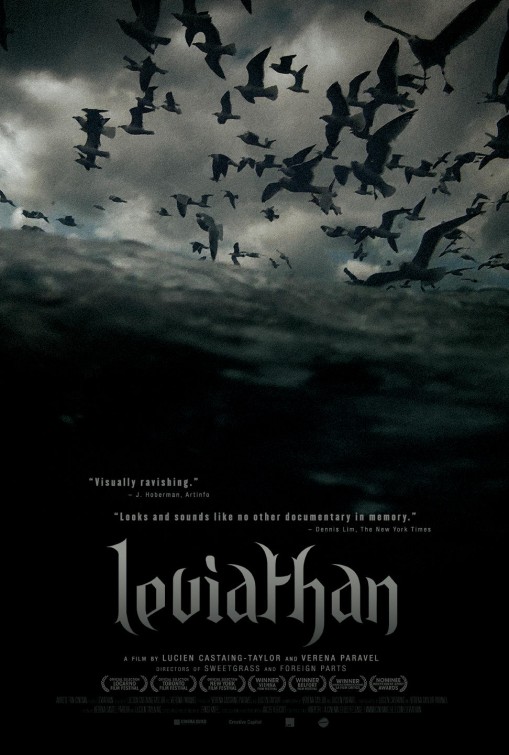
Leviathan (Lucien Castaing-Taylor and Verena Paravel)


by James Hansen


It is practically useless to describe Lucien Castaing-Taylor and Verena Paravel’s experiential documentary Leviathan, surely one of the most enthralling and terrifying films of the year. Ostensibly about the commercial fishing industry, the directors utilize mini-waterproof cameras to gain access to various locations and points of view on board a fishing vessel. While there are certain precedents for this kind of “observational” filmmaking, Leviathan is truly something no one has seen or heard before.

Continue reading...